Reconstructing Chan Master for Contemporary English Readers: A Digital Humanities Approach to the Comic Translation of Chan Shuo

Minying Ye, Xi Chen

Journal of Translation Studies ›› 2025, Vol. 9 ›› Issue (1) : 49-86.

PDF(1876 KB)
PDF(1876 KB)
Journal of Translation Studies ›› 2025, Vol. 9 ›› Issue (1) : 49-86.
Special Issue Articles

Reconstructing Chan Master for Contemporary English Readers: A Digital Humanities Approach to the Comic Translation of Chan Shuo
  • Minying Ye, Xi Chen
Author information +
History +

Abstract

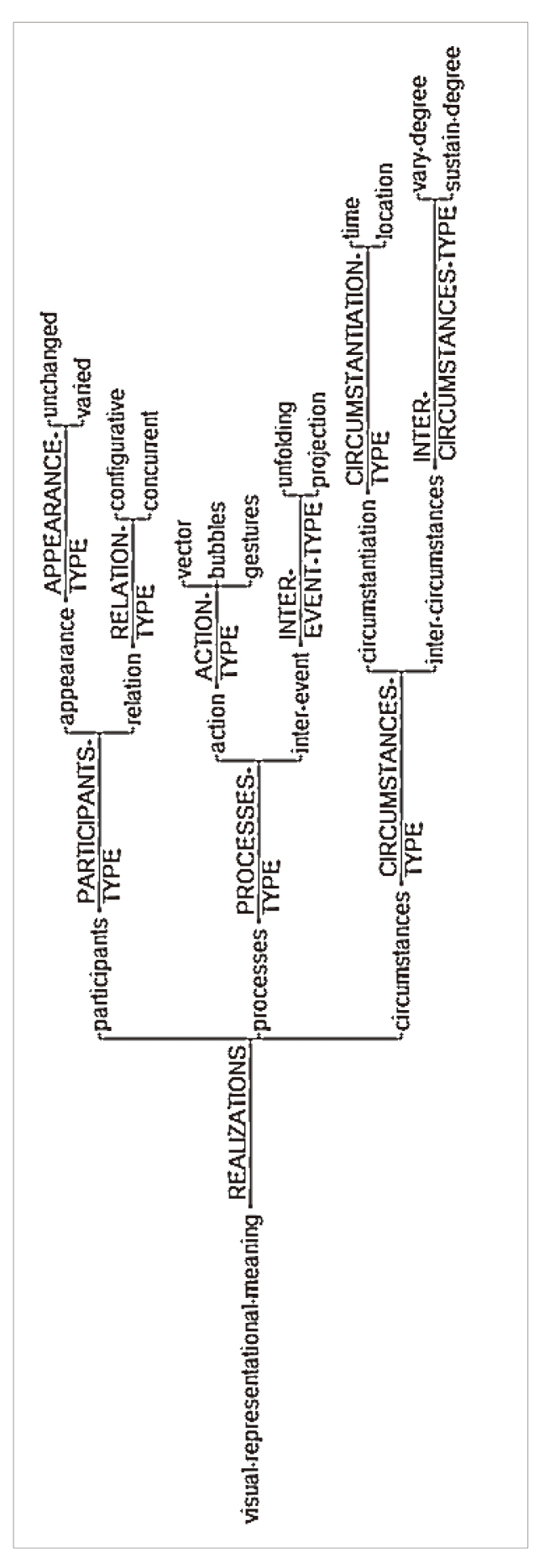
The English translation of the Chinese classic comic Chan Shuo 禪說 has garnered significant attention as a vital medium for introducing Chinese Chan Buddhism to English readers. This study investigates the representational meaning that emerges through the comic translation of Chan Shuo. In a digital humanities (DH) approach, the study first creates a self-built database of bilingual texts and images of Chan Master and then utilizes two tools developed at the Universidad Autónoma de Madrid, UAM CorpusTool and ImageTool, to annotate the database systematically, culminating in an analysis of the multimodal representational realizations of Chan Master. Based on the analytical framework combining visual grammar and visual narrative, it scrutinizes the participants, processes, and circumstances through both quantitative and qualitative methods. Moreover, it seeks to explore the multimodal translation methods to adapt Chan story for contemporary readers by examining the representation of Chan Master’s image through the text- image interplay. The findings indicate that such a multimodal translation adeptly conveys the inclusiveness and dynamism of the Chan Master, effectively transmitting core concepts of Chan Buddhism to the English- speaking world.

Key words

Chan Master / Chan Shuo / representational meaning / multimodal translation / digital humanities


Cite this article

Download Citations
Minying Ye, Xi Chen. Reconstructing Chan Master for Contemporary English Readers: A Digital Humanities Approach to the Comic Translation of Chan Shuo[J]. Journal of Translation Studies. 2025, 9(1): 49-86

References

Abbott, Laurence Frederick (1986). “Comic Art: Characteristics and Potentialities of a Narrative Medium.” Journal of Popular Culture 19(4): 155-176.
Ban, Bo 班柏 (2014). “Wanqing yijiang de Zhongguo fodian Yingyi gaochao” 晚清以降的中國佛典英譯高潮 [The climax of English translation of Chinese Buddhist texts since the late Qing dynasty]. Waiyu jiaoxue yu yanjiu 外語教學與研究(外國語文雙月刊)2: 273-281.
Borodo, Michal (2015).“Multimodality, Translation and Comics.” Perspective 23(1): 22-41.
Chen, Lin 陳琳 (2019). “Cong shengtai yishilun fanyi jiangouxing” 從生態譯詩論翻譯建構性 [On the formative force of translation with verse ecotranslation as a case]. Zhongguo bijiao wenxue 中國比較文學 2: 122-136.
Dai, Yuxia 戴玉霞,Fan Fan 樊凡 (2013). “Hehe lilun guanzhaoxia de Sushi Chanshi Yingyi yanjiu” 和合理論關照下的蘇軾禪詩英譯研究 [The study of English translations of Su Shi’s Zen poems based on the harmony- promoting theory]. Waiyu jiaoxue 外語教學 3: 109-113.
Eckhoff-Heindl, Nina (2022). “Aesthetics of Reception: Uncovering the Modes of Interaction in Comics.” In Seeing Comics through Art History, ed. by Maggie Gray, and Ian Horton, 97-119. Palgrave Macmillan.
Fang, Litian 方立天 (1995). “Chanzong jingshen—Chanzong sixiang de hexin, benzhi ji tedian” 禪宗精神─禪宗思想的核心、本質及特點 [The spirit of Zen—The core, essence and characteristics of Zen thought]. Zhexue yanjiu 哲學研究 3: 66-70.
Gibbons, Alison (2012). Multimodality, Cognition, and Experimental Literature. Routledge.
Gleig, Ann (2019). American Dharma: Buddhism beyond Modernity. Yale University Press.
Halliday, Michael Alexander Kirkwood (1978). Language as Social Semiotic: The Social Interpretation of Language and Meaning. Edward Arnold.
—(1994). An Introduction to Functional Grammar. Arnold.
—(2009). Language and Society. Continuum.
—,Christian Matthias Ingemar Martin Matthiessen (2004). Introduction to Functional Grammar. Arnold.
Huang, Libo (2015). Style in Translation: A Corpus-Based Perspective. Shanghai Jiao Tong University Press and Springer.
Huang, Lihe,Huiyu Qu (2022). “Decoding Multimodal Resources in the Master-Disciple Interactions of Chinese Zen Buddhism.” Chinese Semiotic Studies 4(18): 563-580.
Jiang, Jiansong 蔣堅松 (2014). “Tanjing yu Zhongguo Chanwenhua de guowai chuanbo—jianlun dianji Yingyi de yizhong celüe”《壇經》與中國禪文化的國外傳播— 兼論典籍英譯的一種策略 [Tanjing and the communication of Chinese Zen culture abroad—A study on a strategy for the English translation of classics]. Yanshan daxue xuebao 燕山大學學報(哲學社科科學版)4: 48-53.
Kaindl, Klaus (1999). “Thump, Whizz, Poom: A Framework for the Study of Comics under Translation.” Target 11(2): 263-288.
Kerouac, Jack (1958). The Dharma Bums. Viking Press.
Khadem, Amir (2012). “Annexing the Unread: A Close Reading of ‘Distant Reading.’” Neohelicon 39(2): 409-421.
Kress, Gunther,Theo van Leeuwen (1996). Reading Images: The Grammar of Visual Design. Routledge.
—(2006). Reading Images: The Grammar of Visual Design. Routledge.
Ma, Nake 馬納克 (2019). “Chanshixue shijiaoxia de Tanjing Yingyi yanjiu”闡釋學視角下的《壇經》英譯研究 [A study of English translations of Tanjing from the perspective of hermeneutics]. PhD diss., Hunan University 湖南大學 .
Martin, James Robert,David Rose (2007). Working with Discourse: Meaning Beyond the Clause. Bloomsbury Publishing.
McRae, John R. (1986). The Northern School and the Formation of Early Ch’an Buddhism. University of Hawaii Press.
O’Donnell, Mick (2008). “Demonstration of the UAM CorpusTool for Text and Image Annotation.” In Proceedings of the ACL-08: HLT Demo Session (Companion Volume), ed. by Jimmy Lin, 13-16. Association for Computational Linguistics.
Olohan, Maeve (2003). “How Frequent are the Contractions? A Study of Contracted Forms in the Translational English Corpus.” Target 15(1): 59-89.
Painter, Claire, Jeannett Martin, and Len Unsworth (2013). Reading Visual Narratives: Image Analysis in Children’s Picture Books. Equinox Publishing Ltd.
Roszak, Theodore (1969). The Making of a Counter Culture: Reflections on the Technocratic Society and Its Youthful Opposition. Doubleday.
Song, Weihua 宋偉華 (2013). “Tanjing Huang Maolin Yingyiben yu Dwight Goddard Yingyiben bijiao”《壇經》黃茂林英譯本與德懷特.戈達德英譯本比較 [A comparison of the English translations of the Tanjing by Maolin Wong and by Dwight Goddard]. Zhongguo keji fanyi 中國科技翻譯 1: 19-22.
Sun, Yifeng,Defeng Li (2018). “Digital Humanities Approach to Literary Translation.” Comparative Literature Studies 57(4): 640-654.
Tan, Xiaoli 譚曉麗,Brian Bruya 柏嘯虎, (2021). “Zhongguo dianji yijie de manhua meijie—Cai Zhizhong manhua Zhongguo sixiang xilie Yingyizhe Brian Bruya fangtan” 中國典籍譯介的漫畫媒介 — 蔡志忠漫畫中國思想系列英譯者布萊恩.布雅訪談 [A comic medium for the translation of the Chinese canon—An interview with Brian Bruya, English translator of Tsai Chih-chung’s comic Chinese thought series]. Hengyang shifan xueyuan xuebao 衡陽師範學院學報 1: 2.
Tanasescu, Raluca (2023). “Complexity and the Place of Translation in Digital Humanities: Post-Disciplinary Communities of Practice in the Translation Studies Network.” In Exploring the Implications of Complexity Thinking for Translation Studies, ed. by Kobus Marais, and Reine Meylaerts, 30-72. Routledge.
Toury, Gideon (1995). Descriptive Translation Studies and Beyond. John Benjamins.
Tsai, Chih-Chung 蔡志忠 (1989). Chanshuo: zunzhe de banghe 禪說:尊者的棒喝 [Zen sayings: The venerable’s stick or yell to enlighten]. Shenghuo. Dushu.Xinzhi Sanlian shudian 生活.讀書.新知三聯書店 .
—(2005). Zen Stories 禪說: 尊者的棒喝 [Zen sayings: The Staff and Shouts of the Venerable Ones]. Modern Press 現代出版社 .
—(2013). Chan shuo liu zu Tan Jing 禪說.六祖壇經 [Zen Stories: Wisdom of the Zen Masters]. Modern Press 現代出版社 .
—(2018a). The Analects, trans. by Brian Bruya. Princeton University Press.
—(2018b). The Art of War: An Illustrated Edition, trans. by Brian Bruya. Princeton University Press.
—(2019). The Way of Nature, trans. by Brian Bruya. Princeton University Press.
—(2020). Dao de jing, trans. by Brian Bruya. Princeton University Press.
—(2021). The Ways of Zen, trans. by Brian Bruya. Princeton University Press.
Wang, Feng 王鳳 (2013). “Yan yu feiyan de duomotai yinyu yanjiu” 言與非言的多模態隱喻研究 [A study on words and non-words from the perspective of multimodal metaphor]. Waiyu xuekan 外語學刊 2: 12-16.
Wang, Leyang,Di Yu (2022). “UAM CorpusTool: A Convenient and Comprehensive Software.” Scholars International Journal of Linguistics and Literature 5(10): 352-356.
—,Zhaoxia Liu (2022). “A Review on the Weakness of UAM CorpusTool.” EAS Journal of Humanities and Cultural Studies 4(5): 214-218.
Watts, Alan (1957). The Way of Zen. Random House.
Wilson, Virginia (2014). “Research Methods: Triangulation.” Evidence Based Library and Information Practice 9(1): 74-75.
Winters, Marion (2009). “Modal Particles Explained: How Modal Particles Creep into Translations and Reveal Translators’ Styles.” Target 21(1): 74-97.
—(2018). “The Case of Natascha Wodin’s Autobiographical Novels: A Corpus Stylistics Approach.” In The Palgrave Handbook of Literary Translation, ed. by Jean Boase-Beier, Lina Fisher, and Hiroko Furukawa, 145-166. Palgrave Macmillan.
Xiong, Wei 熊偉,Wenjing An 安文婧 (2021). “Tanjing zai Yingyu shijie de yijie yu chuanbo (1930-2020)”《壇經》在英語世界的譯介與傳播 (1930-2020) [The translation and dissemination of the T’an Ching in the English- speaking world (1930-2020)]. Hubei shehui kexue 湖北社會科學 6: 81-89.
Yu, Hailing 于海玲 (2019). “‘Chan’ de kanke xixing lu: ‘Zen’ haishi ‘Chan.’”「禪」的坎坷西行路 —「Zen」還是「Chan」[Chan’s bumpy road to the West: “Zen” or “Chan”?]. Yanshan daxue xuebao 燕山大學學報(哲學社科科學版)5: 23-28.
—,Canzhong Wu (2016). “Recreating the Image of Chan Master Huineng: The Roles of Mood and Modality.” Functional Linguistics 3(4): 1-21.
—,Canzhong Wu (2017). “Recreating the Image of Chan Master Huineng: The Role of Personal Pronouns.” Target International Journal of Translation Studies 29(1): 64-86.
—,Canzhang Wu (2018). “Attitude as Mediation: Peritextual Commentary in the Translation of thePlatform Sutra.” Text & Talk 38(5): 633-654.
—,Shangxing Guo (2016). “The MasterSaid, the Master Exclaimed: Reporting Verbs and the Image of Huineng in Translations of the Platform Sutra.” Asia Pacific Translation and Intercultural Studies 3(3): 267-279.
—,Zhongwei Song (2017). “Picture-Text Congruence in Translation: Images of the Zen Master on Book Covers and in Verbal Texts.” Social Semiotic 27(5): 604-623.
Zhang, Zhifang 張志芳,Bin Zhang 張彬 (2012). Yiyi zaidao: Fodian de chuanyi yu fojiao de Zhongguo hua 譯以載道:佛典的傳譯與佛教的中國化 [Literature is the vehicle of ideas]. Xiamen claxue chubanshe 廈門大學出版社 .
PDF(1876 KB)

Accesses

Citation

Detail

Sections
Recommended

/